
Overview
RTA Outdoors manufactures high-quality outdoor products for residential and commercial customers in a market where sales, order, and operational requirements were becoming more complex over time. As the business grew, the team needed a more reliable way to move work from HubSpot into NetSuite without slowing down sales, finance, or fulfillment.
HubSpot was already managing customer interactions, deal activity, and marketing. NetSuite was already handling order management, financials, and downstream operations.
The friction sat between them.
Work was leaving the CRM, but it was not arriving downstream in a way the rest of the business could act on cleanly.
Before Learners.ai
Before the integration, RTA Outdoors was operating across disconnected systems.
Customer and deal activity lived in HubSpot. Order, inventory, and financial execution lived in NetSuite. Payment tracking and downstream coordination required additional manual effort. Because those systems were not aligned, teams had to work around the process instead of through it.
That created a familiar set of operational issues:
- Customer and order data drifted between systems
- Manual data entry introduced delays and avoidable errors
- Sales order processing was slower than it needed to be
- Payment tracking was harder to manage cleanly
- Reporting was limited because teams did not have a clean view across the customer lifecycle and operational workflow
The Challenge
RTA Outdoors needed to solve more than simple synchronization.
The business needed a cleaner way to move from commercial activity in HubSpot to financial and operational execution in NetSuite. That meant solving several related problems at once:
- Keeping contact data aligned between both systems
- Reducing manual work around payments and installment tracking
- Automatically converting approved HubSpot deals into usable sales orders in NetSuite
- Keeping product information consistent across systems
- Improving visibility so sales, finance, and operations were not working from different versions of the same transaction
Just as important, the solution needed to support growth. The existing process was already straining under current volume, and additional scale would only magnify the friction.
The Solution
Learners.ai designed a HubSpot + NetSuite integration around the workflow moments creating the most friction: customer records, approved deals, product consistency, sales order creation, and payment milestones.
The solution centered on a small number of critical objects rather than trying to flatten both systems into one.
The integration preserved clear system ownership. HubSpot remained the commercial workspace for deals, quotes, products, and payment-related visibility, while NetSuite remained the system of record for sales orders, financial execution, and downstream operations.
That separation mattered because the goal was not to duplicate ERP logic inside the CRM. The goal was to move approved work into NetSuite cleanly while giving HubSpot users enough downstream visibility to coordinate without relying on manual follow-up.
Contact Synchronization Across HubSpot and NetSuite
Contact information was synchronized between HubSpot and NetSuite so teams in sales, support, and operations were no longer working from stale or inconsistent records.
This improved communication quality and reduced the risk of customer-facing mistakes caused by fragmented contact data.
Payment Tracking Inside HubSpot Deals
A custom workflow was built to manage installment-style payment tracking inside HubSpot deals.
Rather than relying on disconnected manual tracking, the team could tie payment-related fields and transaction references back to what was happening downstream in NetSuite. This improved financial visibility and gave the business a more usable way to coordinate around deposits and payment milestones.
Automated Sales Order Creation in NetSuite
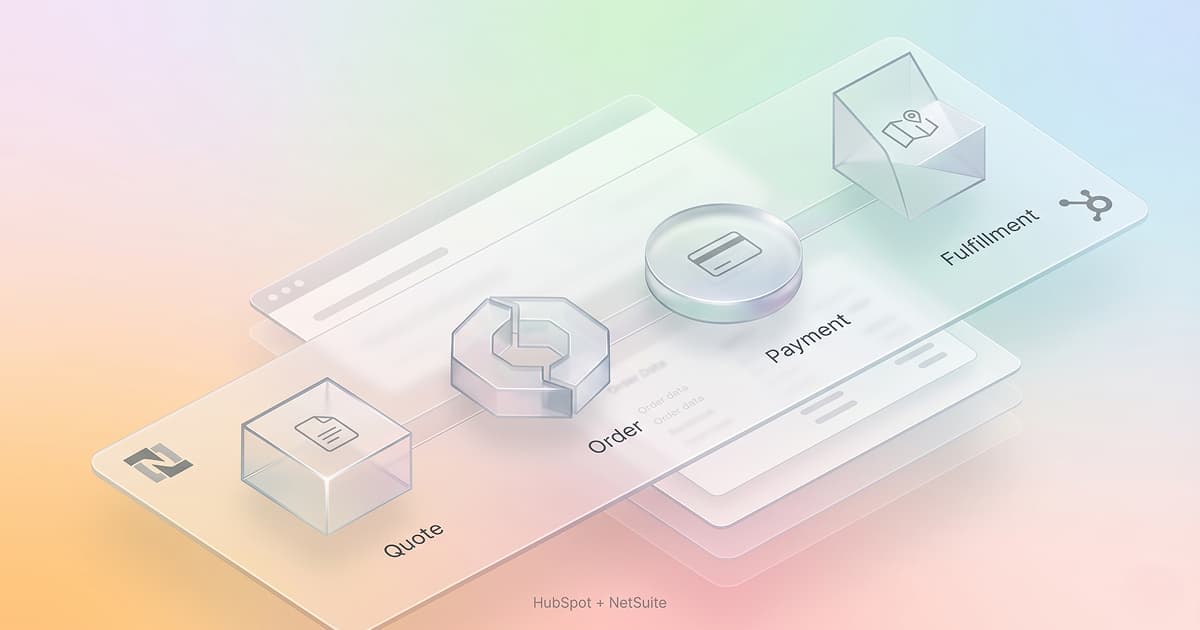
When a deal reached the approved stage in HubSpot, the integration automatically created the corresponding sales order in NetSuite using the last published quote and associated line items.
This removed a major point of manual re-entry, sped up order processing, and reduced the risk of mismatch between what was sold upstream and what operations needed downstream.
Product Synchronization
Products were synchronized between HubSpot and NetSuite to help maintain consistency across quoting and execution.
This reduced the risk of mismatched product data and supported more reliable quote-to-order execution.
What Changed Operationally
This project did more than connect two systems.
It reduced the amount of translation happening between teams.
Approved work in HubSpot no longer had to be rebuilt manually before NetSuite could act on it. Customer data became cleaner across both environments. Payment milestones were easier to track. Sales, finance, and operations gained a more consistent view of the same transaction as it moved from commercial approval into downstream execution.
That is where much of the value came from.
Not from "having an integration" in the abstract, but from improving the actual business handoff between CRM activity and ERP execution.
Key Systems Integrated and Manual Work Reduced
Integrated
- HubSpot CRM
- NetSuite ERP
- HubSpot deals, quotes, products, and payment-related deal data
- Sales order creation and downstream financial coordination across systems
Reduced or replaced
- Manual data entry between HubSpot and NetSuite
- Spreadsheet-style or disconnected payment tracking
- Internal handoffs that depended on rebuilding records downstream
- Fragmented product and customer information across systems
The Results
The integration improved the way RTA Outdoors moved work from HubSpot into NetSuite.
Approved deals no longer had to be manually rebuilt downstream before the business could act. Sales order creation became cleaner. Product and contact data stayed more consistent across systems. Payment tracking became easier to coordinate from HubSpot, while NetSuite remained the system of record for financial and operational execution.
The biggest improvements showed up in four areas:
- Less manual re-entry between HubSpot and NetSuite
- More reliable quote-to-order execution
- Better visibility into payment milestones
- More reliable customer and product data across both systems
The result was a more controlled handoff between sales, finance, and operations.
Instead of relying on internal follow-up to understand what happened after a deal was approved, teams had a clearer path from HubSpot activity to NetSuite execution.
Why It Worked
The project worked because the integration respected the role of each system.
HubSpot remained the workspace for commercial activity, deal context, payment visibility, and customer coordination. NetSuite remained the system of record for sales orders, financial execution, and downstream operations.
That clear separation reduced the need for teams to translate work manually between systems. Approved deals could move into NetSuite more cleanly, while HubSpot users gained enough downstream visibility to coordinate with more confidence.
Strategic Takeaway
For manufacturers and product-driven businesses, the gap between CRM activity and ERP execution can become a major source of operational drag.
RTA Outdoors is a strong example of what happens when that gap is handled properly. By connecting HubSpot and NetSuite around customer records, quote-to-order movement, product synchronization, and payment tracking, the company created a more controlled path from deal approval to execution.